Peronist order
The Disappearance of Josef MengelePeronist order was the political and social arrangement built around Juan Perón and Eva Perón: a program of national independence, worker inclusion, and popular dignity secured through an increasingly authoritarian state. It promised to overcome Argentina’s dependence on foreign capital and the divisions between individualism and collectivism, while drawing mass loyalty to its leaders. Its fall in 1955 brought not a simple return to pluralism but a new campaign to erase Peronist symbols, and its earlier political environment formed part of the postwar refuge in which Nazi fugitives operated.
A program of national renewal
By 1946, Juan Perón and Eva Perón had become the country’s dominant political figures, backed by the church, military, nationalists, and proletariat. Their project presented Argentina’s transformation as both aesthetic and industrial: a proletarian regime would end humiliation and dependency and inaugurate a new national beginning. Radio addresses and public appearances made Juan Perón the conspicuous voice of that promise, while Peronism, also called Justicialism, was offered as the creed that would secure Argentina a place in history.
The program had a material dimension. As secretary of welfare, Juan Perón extended benefits to workers; as president, he strengthened public services and brought the General Confederation of Labour into the state apparatus. His government centralized and nationalized railways, the telephone network, and other strategic sectors that had been in foreign hands. These measures were presented as a route to growth, self-sufficiency, pride, and dignity, and as a direct challenge to the privileges of the oligarchy. The order therefore tied popular incorporation to a stronger central state rather than treating them as competing goals.
Its political language sought to reconcile claims that were usually framed as opposites. Juan Perón described human beings as divided between aspiration and brute impulse, and rejected both capitalism, which he said exploited the individual, and communism, which he said enslaved him. Peronism was presented as a popular compromise between body and soul, the monastic ideal and the consumer ideal, individualism and collectivism. The proposed destination was a national, social, and Christian Argentina. This synthesis gave the movement an expansive promise, but also made the leader and state arbiters of what counted as a legitimate reconciliation.
Mass politics and social provision
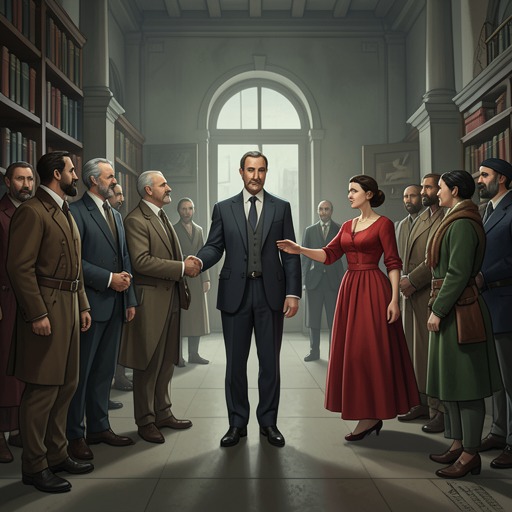
Eva Perón gave the project a public face distinct from her husband’s presidential authority. She received trade union delegates in evening dress, visited hospitals and factories, opened new road sections, and distributed practical goods such as dentures and sewing machines. Her foundation assisted poor and underprivileged people, while her tours carried the movement’s message to crowds across the country. In 1947, her international profile was reinforced by the so-called rainbow tour, during which she met Pope Pius XII and several heads of state.
The relationship between leader and public was staged as more than administrative service. Crowds gathered at the Ministry of Labour and the foundation’s headquarters to see Eva Perón, exchange words, or touch her hand; the account describes that contact in devotional terms. The foundation’s budget increased tenfold, and campaign posters and banners made her image a prominent political symbol in Buenos Aires. The reach of this symbolism was especially visible at the mass rally of 22 August 1951. Hundreds of thousands assembled for the announcement of the couple’s candidacy, and the crowd pressed Eva Perón to accept the vice-presidential nomination. She asked for time to decide, then promised to announce her answer on the radio that evening. The scene reveals both the strength of her personal following and the pressure that mass acclamation could place on political choice.
Centralization and political control
The promise of popular inclusion coexisted with a narrowing of institutional independence. Peronists consolidated a nationalist and authoritarian order by purging universities, the press, legal institutions, and administrative systems, while expanding the secret service. The government’s approach to culture was captured in the slogan “Espadrilles, yes; books, no!” Jorge Luis Borges lost his position at the National Library and was assigned to inspect poultry and rabbits. The contrast between social mobilization and intellectual exclusion shows that the order’s claim to represent the people did not imply tolerance of independent institutions or dissenting voices.
When international events frustrated Juan Perón’s larger ambitions, the government turned attention to re-election and tightened its control. Defamation of authorities was prohibited, newspapers were censored, and La Prensa was closed, expropriated, and made an instrument of the General Confederation of Labour. Military personnel numbers doubled, propaganda intensified, and dissidents were imprisoned; some parliamentarians sought refuge in Montevideo. Eva Perón was invited to run for vice president, while the scale of her foundation and her visibility in the campaign expanded. These measures joined the welfare state and mass appeal to restrictions that made political authority harder to challenge.
The order’s own supporters did not all regard its achievements as convincing. In the account of the 1951 rally, two Nazi exiles viewed the crowd and Peronist political theatre with contempt, interpreting the regime as a comic-opera dictatorship rather than a durable model. They also judged its economic promises against visible failures: potholes in central Buenos Aires, unreliable trains, an economy they considered unproductive, and a costly nuclear project in Patagonia that produced no electricity. Their perspective is hostile and cannot stand as a neutral assessment of the country, but it provides a pointed contrast between the regime’s language of national greatness and the disappointments perceived by observers within its own political orbit.
Crisis, overthrow, and attempted erasure
The order entered a decisive crisis in 1955. On 16 June, anti-Peronist military leaders bombed the presidential palace and May Square; Juan Perón survived the coup attempt, but his position was gravely weakened. Conflict with the Church had intensified after the government ended subsidies to religious schools, legalized divorce and prostitution, and encouraged the growth of religious sects. Demonstrations and counter-demonstrations, arrests, and reprisals accompanied a widening political rupture. By September, mutinies had spread and the navy blockaded Buenos Aires, threatening the refineries.
Juan Perón resigned as Argentina approached civil war. He destroyed compromising files and escaped aboard a Paraguayan gunboat bound for Asunción. A military junta took power, followed within weeks by the government of Pedro Eugenio Aramburu, which promised to purge Peronism. The subsequent measures reached beyond officials and institutions to signs of the movement’s presence in ordinary life. Public display of images of the former leader and his deceased wife, and public use of Peronist names and expressions, could bring prison sentences. Union leaders were arrested, thousands of officials dismissed, and places bearing the name Perón were renamed. Eva Perón’s foundation was closed; its property was dismantled, and statues were toppled. Her embalmed body disappeared.
This was not merely a change of administration. The new authorities sought to make the defeated order unspeakable and to remove its symbols from public space. The counter-image was visible in Jorge Luis Borges’s appointment as head of the National Library and professor at the Buenos Aires Faculty of Letters, while Juan Perón began a gilded exile in Panama. The reversal demonstrates how quickly the institutions and public commemorations associated with Peronist power could be reorganized by its opponents, even as the scale of the preceding popular movement made complete erasure impossible.
Afterlife and historical significance
Peronist order matters to the wider narrative not only as a domestic political project but as part of the unstable postwar setting in which Nazi fugitives sought shelter. The account describes Argentina under Peronist and military predecessors as more lenient toward Nazis than a later liberal government might be. When a West German arrest warrant for Josef Mengele was issued in 1959, the possibility that Argentina would comply with an extradition request helped precipitate his flight to Paraguay. This does not make Peronism the sole cause of his refuge: the evidence also identifies networks of personal assistance, Paraguayan citizenship, and later protection elsewhere. It does show how shifts in government could change the perceived risks of remaining in Argentina.
The political landscape after the 1955 overthrow remained consequential. Following the capture of Adolf Eichmann in 1960, the hunt for Nazi war criminals became more public, and Argentina faced pressure to demonstrate that it was not a Nazi sanctuary. Nazi groups in Buenos Aires began to fragment, while West Germany confronted demands that it judge its own criminals and face its past. Peronist order thus occupies a double position in the narrative: it is a project of social incorporation and national sovereignty, undone by a military-political counterrevolution, and part of a postwar environment whose protections and uncertainties shaped the movements of fugitives.